

Individual Paint Brushes vs Brush Sets: Which Should You Buy?
Share
Most painters start with a brush set. A few months later they notice something: two or three brushes do almost all the work, a few never leave the jar, and the one size they actually need is missing. That is the point where buying individual brushes starts to make sense.
The Short Answer
- Buy a set if you are starting a new medium, do not yet know which shapes you prefer, or want a gift that covers everything.
- Buy individual brushes if you already paint regularly, have worn out a favorite size, or need one specific shape (a fan for foliage, a mop for washes, a petal for florals) without paying for a full set.
When a Brush Set Is the Better Buy
A set gives you a range of shapes and sizes in one go, so you can find out what suits your style. Per brush, a set usually costs less than buying the same brushes one by one. It is the right choice when:
- You are new to acrylic, watercolor or gouache and still experimenting
- You want a matched set with consistent handles and bristles
- You are buying for a student or as a gift
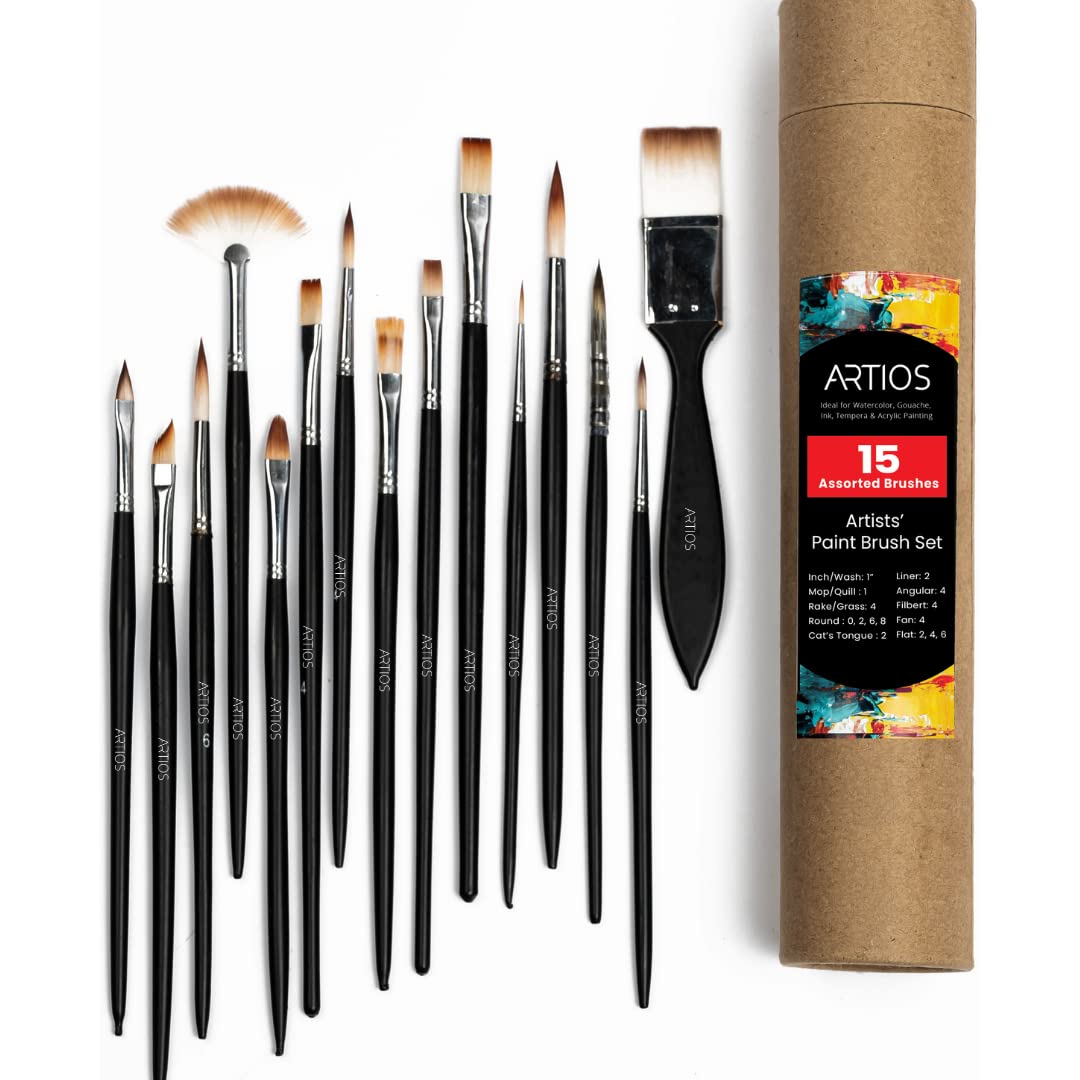
If that is you, start with a versatile set such as the ARTIOS paint brush sets, then add singles later.
When Individual Brushes Make More Sense
Once you know how you paint, a full set means paying for brushes you will not use. Individual brushes let you:
- Replace the one that wore out. Your most-used round usually loses its point first. Replace just that size.
- Add a specialty shape. Fan, mop, petal and angular brushes are used for specific effects. One good brush is often enough.
- Fill a size gap. If your set jumps from a 4 to an 8, add a 6.
- Keep duplicates. Many watercolorists keep two of their main round, one for clean water and one for pigment.
Which Single Brushes to Buy First
| Shape | What it does | Good first size |
|---|---|---|
| Round | Lines, details and general painting. The most-used shape. | 4 or 6 |
| Flat | Sharp edges, blocks of color, backgrounds | 6 or 8 |
| Filbert | Soft edges and blending, portraits, petals | 6 |
| Angular | Clean corners, curves and controlled strokes | 6 |
| Fan | Grass, foliage, texture and soft blending | 4 or 6 |
| Mop | Large watercolor washes and wet-on-wet | 4 or 8 |
| Flat wash | Wetting paper, skies and broad coverage | 1 inch |
| Petal | One-stroke petals, leaves and decorative strokes | 1 |
If you only buy one single brush, make it a round in the size you use most. It is the shape that wears out fastest and the one you will reach for in almost every painting.
How to Read Brush Sizes
Brush sizes are not standard across brands, so a size 6 from one maker can be noticeably bigger or smaller than another's. Within one brand, a higher number means a larger brush. Wash brushes are usually sized by width in inches instead. When you are replacing a brush, buy from the same range as the one you liked so the size matches what you are used to.
For more on shapes, see Round vs Flat vs Filbert Brushes and How to Choose the Right Paint Brushes.
Frequently Asked Questions
Is it cheaper to buy a brush set or individual brushes?
Per brush, a set is usually cheaper. Overall, individual brushes are cheaper when you only need one or two specific shapes or sizes.
Can I mix brushes from a set with single brushes?
Yes. Most painters do exactly this: a set as the base, then singles for the shapes and sizes they use most.
Which brushes wear out first?
Small rounds and liners, because their fine point is what you rely on and it is the first thing to splay. Good cleaning helps. See How to Clean and Care for Paint Brushes.
Are synthetic brushes good enough for watercolor?
For most painters, yes. Modern synthetic bristles hold a point and carry water well, and they are easier to care for than natural hair. The full comparison is in Synthetic vs Natural Hair Brushes.
Browse ARTIOS individual paint brushes by shape: round, flat, filbert, angular, fan, mop, flat wash and petal, each with handmade cruelty-free synthetic bristles. Or start with a brush set and add singles as you go.