
Watercolor Brushes for Beginners: The 3 Brushes You Actually Need
Share
To start watercolor you need three brushes: a medium round around size 6, a small round around size 2, and a mop brush for washes. With those three you can paint skies, leaves, buildings and fine detail. Everything else is a nice extra you can add once you know how you like to paint.
Beginners often buy a big set and then use only two brushes from it. Here is what each of the three does, which sizes to pick, and what to add later.
1. A Medium Round Brush (Size 6 or 8)
This is the brush you will use for most of every painting. A round brush has bristles that bulge in the middle and taper to a point, so one brush can make a broad stroke when pressed down and a fairly thin line when you lift up onto the tip.
A size 6 holds enough water to paint a small area in one go, such as a tree, a pot or a patch of sky in a postcard-sized painting. It is still pointed enough to paint branches and petals. If you tend to paint on A4 or larger, a size 8 gives you a bit more capacity.
Look for a round that comes back to a sharp point when you flick it gently after wetting it. That spring and point matter more than the brand name.
2. A Small Round Brush (Size 1 or 2)
The small round handles everything the medium brush is too big for: eyes, window frames, stems, the veins on a leaf, a signature. Because it holds less water, it gives you more control and less risk of a sudden blob.
New painters tend to reach for the small brush too early and too often, which makes paintings look tight and fussy. Treat it as a finishing brush. Do most of the painting with the size 6 and pick up the size 2 only in the last stage.
3. A Mop Brush for Washes
A mop is a round brush with a big, soft, full belly. It soaks up a lot of water and paint and releases it smoothly, which makes it ideal for skies, backgrounds, wetting the paper before wet-on-wet work, and softening edges.
Painting a sky with a size 6 round means many strokes and many chances for streaks. With a mop you can cover the same area in a few strokes while it is all still wet, and the result is far more even. A size 4 mop suits A5 and small A4 paintings. A size 8 handles larger washes easily. We cover this brush in detail in Mop Brushes for Watercolor.
The Three Brushes at a Glance
| Brush | Good size | What it does | When you use it |
|---|---|---|---|
| Medium round | 6 or 8 | Shapes, general painting, medium detail | Most of the painting |
| Small round | 1 or 2 | Fine lines and small details | Final stage |
| Mop | 4 or 8 | Large washes, wetting paper, soft blending | First stage, skies and backgrounds |
Synthetic or Natural Hair
For a beginner, synthetic is the practical choice. Good modern synthetic bristles hold a point and carry a fair amount of water, they cost less, and they survive the occasional mistake like being left in the water jar. Natural hair holds more water but needs gentler care. The full comparison is in Synthetic vs Natural Hair Brushes.
Brush sizes also vary between brands. A size 6 from one maker can be quite a bit larger than another's, so treat the numbers as a guide and look at the actual length and width of the bristles when you can.
Buying Them as a Set or One at a Time
You can buy exactly these three brushes individually. That keeps things simple and makes it clear which brush does what.
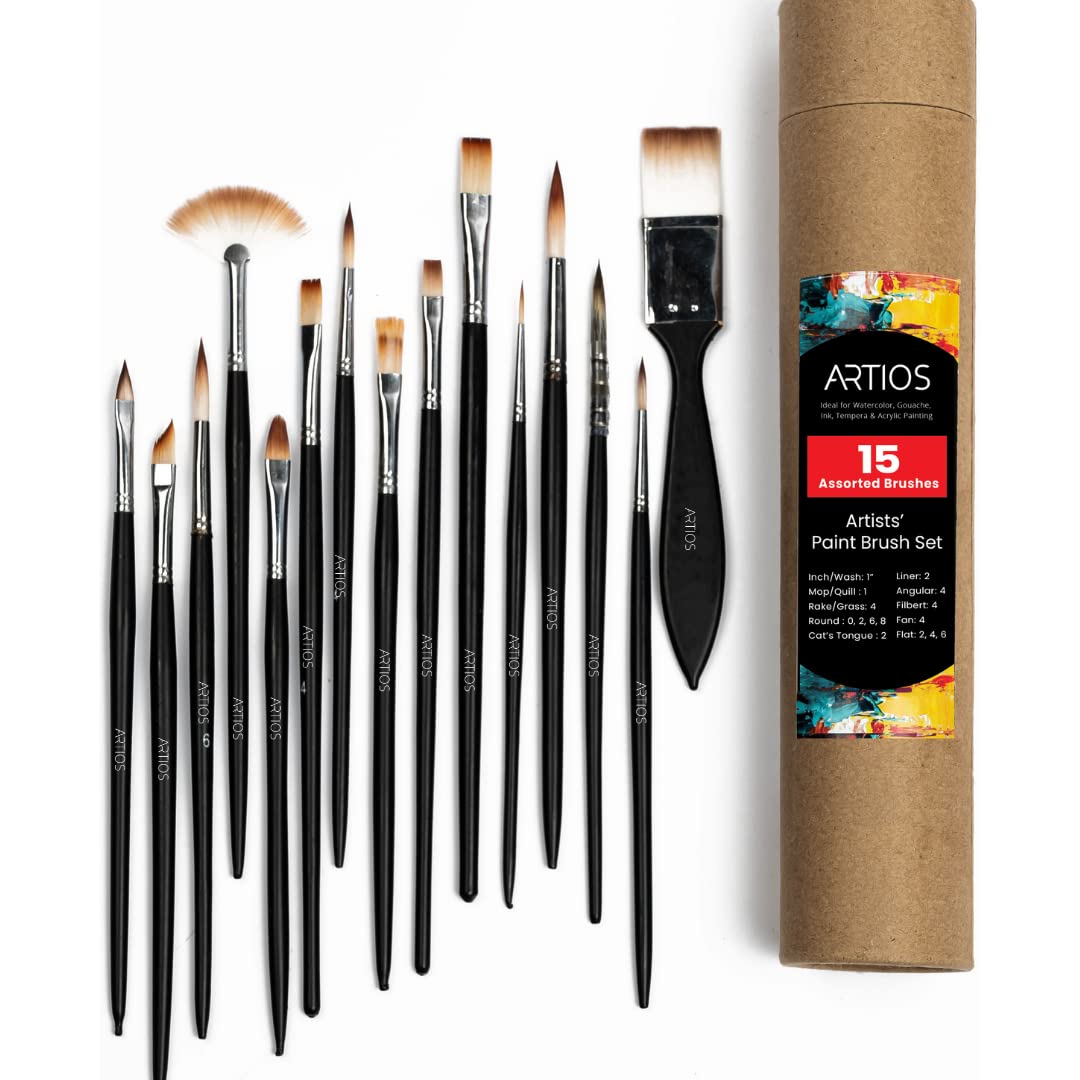
A round set is also a sensible route, since it gives you both your medium and small rounds plus a few extra sizes to experiment with. The ARTIOS Round Set of 7 includes sizes 0, 1, 2, 4, 6, 8 and 10 with synthetic bristles, so it covers the first two brushes on this list. Add a single mop from our individual mop brushes, available in sizes 0, 2, 4 and 8, and you have the full starting kit.
If you would like to compare the two approaches, read Individual Paint Brushes vs Brush Sets.
What to Add Later
Once you have painted with the three basics for a while, you will start to notice gaps. These are the usual next purchases:
- A flat wash brush, around 1 inch wide, for wetting large sheets quickly and painting straight-edged skies and water.
- A liner or rigger for long thin lines like branches, grass and rigging on boats.
- A second mop in a different size, so you have one for big washes and one for smaller soft areas.
- A larger round, size 10 or 12, if you move to A3 paper.
Buy these when a painting shows you need one. A brush you bought for a reason gets used. A brush you bought just in case usually does not.
Looking After Your Three Brushes
With only three brushes, each one matters. Rinse them in clean water as soon as you finish, reshape the tip with your fingers, and let them dry flat or standing bristles up. Never leave a brush resting on its tip in the water jar, because the bristles bend and rarely recover. Our brush care guide covers washing and storage step by step.
Frequently Asked Questions
Can I start watercolor with just one brush?
You can. If you only buy one, choose a size 6 or 8 round with a good point. You will manage small paintings, though large skies will be slower and less even.
Do I need a flat brush for watercolor?
Not at the start. A flat wash brush becomes useful later for large sheets and hard-edged shapes, but a round and a mop handle almost everything a beginner paints.
Can I use acrylic brushes for watercolor?
Stiff acrylic brushes do not hold much water and tend to scrub the paper. Soft synthetic brushes work for both, but keep a separate set for watercolor if you paint in both media, as dried acrylic in the bristles is hard to remove.
Why does my round brush not come to a point?
Either it is a low-quality brush, or the tip has been bent by resting in water. Wet it, reshape it with your fingers, and let it dry standing up. If it still splays, it is time for a new one.
For the rest of your kit, including brushes, palettes and paper, see the ARTIOS Watercolor Supplies collection.